


Underpriced Pokémon cards are listed on eBay every day, and they are the first listings to sell. Here is why they happen, how to look for them yourself, and how to have them sent to you instead.
Underpriced listings, not undervalued cards
Search for underpriced Pokémon cards and most of what comes back is lists of cards somebody expects to rise in value. This guide is about something different.
Not this guide
An undervalued card
- A prediction that a card will be worth more later
- You buy, wait, and hope the market agrees
This guide
An underpriced listing
- One seller, today, listing a card for less than it normally sells for
- You do not need a prediction
- You need to see the listing before someone else buys it
Why cards get listed too low
-
The seller wants it gone
People clearing out a collection often price to sell today, not to get the last pound.
-
The title is missing something
No set name, no collector number, or the Pokémon’s name spelled wrong. Buyers searching for the exact card never see the listing, so it sits there cheap.
Example titlePikchu 241 holo
-
The seller priced the wrong printing
Many Pokémon have dozens of different cards. A seller looks up the common one and lists the rare one at that price.
-
The title says almost nothing
Only someone who recognises the card from the picture knows what it is.
Example titlePokémon card holo rare
-
An auction nobody notices
It starts low, the same title problems apply, and fewer watchers means a lower final price.
How to look for them yourself
- Learn the going rate first. On eBay, filter a search to sold items to see what the card has actually sold for recently. Postage counts.
- Search the way sellers write. Try the name with the number and no set, the name alone, and the usual misspellings.
- Sort by newly listed. An underpriced Buy It Now listing does not last, so the newest listings are the ones worth checking.
- Read the listing before you buy. A low price is sometimes low for a reason: damage, a different language, a different printing, or a card that is not genuine.
Doing this for one card is manageable. Doing it for twenty, several times a day, is not.
Or let Toru do the watching for you.Free. No payment details, no subscription.
Create free accountLet the listings come to you
You pick the exact card and the most you would pay, postage included. Toru watches eBay UK and sends you a notification when a listing comes in at or under your price.
- Matched by set and collector number, and Toru copes with the misspellings sellers make
- When a title is too vague to be sure, Toru can compare the listing’s photo with the real card art
- Raw or graded, auctions in or out, and words a title must or must not contain
- Free on iPhone, Android and the web, with no subscription and no payment details
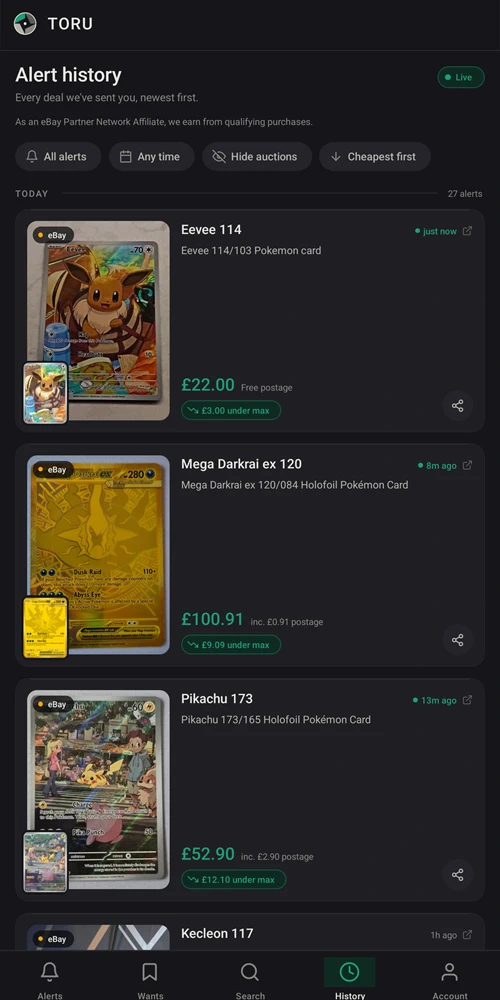
Picking a max price that catches deals
Set your max a little below what the card usually sells for. Too low and nothing qualifies. Too high and ordinary listings get through.
When you create an alert, Toru links you to the card’s recently sold listings on eBay so you can check the going rate first.
- Ordinary listings, around the usual price. No alert.
- One listed under your max. This is the alert.
What Toru does not do
Toru tells you a listing exists. It does not value cards, grade them or check that they are genuine, and it never buys anything for you. Everything after the alert is between you and the seller, so read the listing before you pay.
Start watching for your card.
Your first alert takes about a minute.


Toru may earn a commission when you buy through a link in an alert. It costs you nothing extra and never changes which alerts you get.